What are the benefits of Massage?
Increases Range of Motion
Improves Stamina
Enhances Performance and Gait Quality
Improves Circulation
Provides Comfort to Muscle Injury and Soreness
Improves Disposition
Reduces Tactile Defense
How often should a horse be massaged?
This depends on the horse's level of work. The high
performance horse will benefit from massage twice a month;
The normal working horse should be massaged every four to
six weeks; and the retired horse will respond well to a
massage every six to eight weeks.
How long must I wait to work my horse
after a massage?
Follow up exercise is a component of equine massage.
Healthy and sound horses can be ridden lightly immediately
following a massage and normal workouts can resume the
following day.
Is each massage the same for every horse?
Definitely not! Every massage is tailored to meet the specific
demands of each individual horse and the sport that they
perform. Each massage will address the full body, but more
emphasis will be placed on the muscles that each horse uses
most and this will vary greatly based on the work that each
horse performs. In addition, each horse will have its unique
"positive" points which will be addressed during each session.
What is your service area?
I travel within a 125 mile radius of Richmond Hill, Georgia.
This includes all of Coastal Georgia and points west of there,
Beaufort and Jasper counties in South Carolina and areas
north of Jacksonville in Florida. Trip fees may apply.
When should a horse NOT be massaged?
A horse should not be massaged when:
there is abnormal heat or swelling present
a weight bearing lameness exists
the horse is lethargic or has a lack of appetite
the horse has an elevated pulse, respiration or temperature
there is a significant injury less than seven days old
a proper diagnosis is lacking
How can I tell if my horse could use a
massage?
Your horse cannot speak in words to tell you when he is
hurting. However his body language is a very accurate
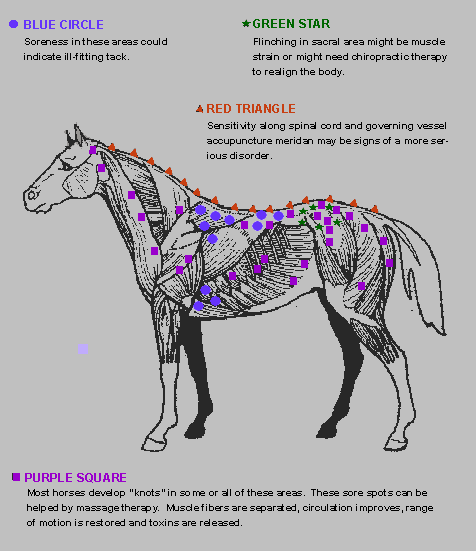
indicator of problems. Use the following diagram to test your
horse and see how he feels. This will help you determine if
there are trouble spots that may be affecting his performance
and health.
Increases Range of Motion
Improves Stamina
Enhances Performance and Gait Quality
Improves Circulation
Provides Comfort to Muscle Injury and Soreness
Improves Disposition
Reduces Tactile Defense
How often should a horse be massaged?
This depends on the horse's level of work. The high
performance horse will benefit from massage twice a month;
The normal working horse should be massaged every four to
six weeks; and the retired horse will respond well to a
massage every six to eight weeks.
How long must I wait to work my horse
after a massage?
Follow up exercise is a component of equine massage.
Healthy and sound horses can be ridden lightly immediately
following a massage and normal workouts can resume the
following day.
Is each massage the same for every horse?
Definitely not! Every massage is tailored to meet the specific
demands of each individual horse and the sport that they
perform. Each massage will address the full body, but more
emphasis will be placed on the muscles that each horse uses
most and this will vary greatly based on the work that each
horse performs. In addition, each horse will have its unique
"positive" points which will be addressed during each session.
What is your service area?
I travel within a 125 mile radius of Richmond Hill, Georgia.
This includes all of Coastal Georgia and points west of there,
Beaufort and Jasper counties in South Carolina and areas
north of Jacksonville in Florida. Trip fees may apply.
When should a horse NOT be massaged?
A horse should not be massaged when:
there is abnormal heat or swelling present
a weight bearing lameness exists
the horse is lethargic or has a lack of appetite
the horse has an elevated pulse, respiration or temperature
there is a significant injury less than seven days old
a proper diagnosis is lacking
How can I tell if my horse could use a
massage?
Your horse cannot speak in words to tell you when he is
hurting. However his body language is a very accurate
indicator of problems. Use the following diagram to test your
horse and see how he feels. This will help you determine if
there are trouble spots that may be affecting his performance
and health.
| Stride Right Equine Massage Therapy |

| Massage therapy is meant to be used in conjunction with traditional veterinary medicine; it is not a substitute. |
Using your index and middle fingers, palpate or press
down using as much pressure as you can tolerate on your
forearm along the areas illustrated above. Palpations
should be no greater than 2 inches apart. If your horse
flinches, sinks, moves away, pins his ears etc. he might
have a problem. Muscles that are compromised will react
to palpation. This is not intended to be a diagnosis, but
will help you help your horse by determining if he has
problem areas that need attention.
down using as much pressure as you can tolerate on your
forearm along the areas illustrated above. Palpations
should be no greater than 2 inches apart. If your horse
flinches, sinks, moves away, pins his ears etc. he might
have a problem. Muscles that are compromised will react
to palpation. This is not intended to be a diagnosis, but
will help you help your horse by determining if he has
problem areas that need attention.
| Stride Right Equine Massage Therapy Serving Savannah, GA and surrounding areas 912-660-1706 Cara@striderightequinemassagetherapy.com |
 | |  | |  | |  |